January Newsletter͏‌ ͏‌ ͏‌ ͏‌ ͏‌ ͏‌ ͏‌ ͏‌ ͏‌ ͏‌ ͏‌ ͏‌ ͏‌ ͏‌ ͏‌ ͏‌ ͏‌ ͏‌ ͏‌ ͏‌ ͏‌ ͏‌ ͏‌ ͏‌ ͏‌ ͏‌ ͏‌ ͏‌ ͏‌ ͏‌ ͏‌ ͏‌ ͏‌ ͏‌ ͏‌ ͏‌ ͏‌ ͏‌ ͏‌ ͏‌ ͏‌ ͏‌ ͏‌ ͏‌ ͏‌ ͏‌ ͏‌ ͏‌ ͏‌ ͏‌ ͏‌ ͏‌ ͏‌ ͏‌ ͏‌ ͏‌ ͏‌ ͏‌ ͏‌ ͏‌ ͏‌ ͏‌ ͏‌ ͏‌ ͏‌ ͏‌ ͏‌ ͏‌ ͏‌ ͏‌ ͏‌ ͏‌ ͏‌ ͏‌ ͏‌ ͏‌ ͏‌ ͏‌ ͏‌ ͏‌ ͏‌ ͏‌ ͏‌ ͏‌ ͏‌ ͏‌ ͏‌ ͏‌ ͏‌ ͏‌ ͏‌ ͏‌ ͏‌ ͏‌ ͏‌ ͏‌ ͏‌ ͏‌ ͏‌ ͏‌ ͏‌ ͏‌ ͏‌ ͏‌ ͏‌ ͏‌ ͏‌ ͏‌ ͏‌ ͏‌ ͏‌ ͏‌ ͏‌ ͏‌ ͏‌ ͏‌ ͏‌ ͏‌ ͏‌ ͏‌ ͏‌ ͏‌ ͏‌ ͏‌ ͏‌ ͏‌ ͏‌ ͏‌ ͏‌ ͏‌ ͏‌ ͏‌ ͏‌ ͏‌ ͏‌ ͏‌ ͏‌ ͏‌ ͏‌ ͏‌ ͏‌ ͏‌ ͏‌ ͏‌ ͏‌ ͏‌ ͏‌ ͏‌ ͏‌ ͏‌ ͏‌ ͏‌ ͏‌ ͏‌ ͏‌ ͏‌ ͏‌ ͏‌ ͏‌ ͏‌ ͏‌ ͏‌ ͏‌ ͏‌ ͏‌ ͏‌ ͏‌ ͏‌ ͏‌ ͏‌ ͏‌ ͏‌ ͏‌ ͏‌ ͏‌ ͏‌ ͏‌ ͏‌ ͏‌ ͏‌ ͏‌ ͏‌ ͏‌ ͏‌ ͏‌ ͏‌ ͏‌ ͏‌ ͏‌ ͏‌ ͏‌ ͏‌ ͏‌ ͏‌ ͏‌ ͏‌ ͏‌ ͏‌ ͏‌ ͏‌ ͏‌ ͏‌ ͏‌ ͏‌ ͏‌ ͏‌ ͏‌ ͏‌ ͏‌ ͏‌ ͏‌ ͏‌ ͏‌ ͏‌ ͏‌ ͏‌ ͏‌ ͏‌ ͏‌ ͏‌ ͏‌ ͏‌ ͏‌ ͏‌ ͏‌ ͏‌ ͏‌ ͏‌ ͏‌ ͏‌ ͏‌ ͏‌ ͏‌ ͏‌ ͏‌ ͏‌ ͏‌ ͏‌ ͏‌ ͏‌ ͏‌ ͏‌ ͏‌ ͏‌ ͏‌ ͏‌ ͏‌ ͏‌ ͏‌ ͏‌ ͏‌ ͏‌ ͏‌ ͏‌ ͏‌ 
ShoeboxTasks

January Newsletter

Dear Friends,

The new year is here and for many it is seen as a time to make a fresh start and establish some New Year’s resolutions. This often involves changes in our behavior that we feel will benefit us, and perhaps others, in good ways. This month’s newsletter focuses on how to successfully introduce change to children on the autism spectrum.

If you are interested in a consultation with me on how to adapt a ShoeboxTasks® activity to support change, please contact me at ron@shoeboxtasks.com or call (828) 252-5111.

Thank you, Ron Larsen, Centering on Children


Change can be challenging

Making changes is not always easy. It requires effort, consistency and persistence, all of which can be quite challenging. This is also true for young children on the autism spectrum with whom we live, teach, or guide during therapy sessions.

We all may be familiar with the child who plays with blocks the same way each time. S/he lines them up in train-like formation and never uses them in any other way. Children on the autism spectrum establish patterns, routines and set ways of doing things rather quickly, and it can be very difficult to introduce change to an existing behavioral pattern. The most dramatic example of such behavior I experienced, was a young girl who had come to the TEACCH center for a therapy session. As her parents waited, the young girl walked the hallway that circled around the building. I followed her and noticed when confronted by two therapists talking in the hallway, she sidestepped around them and continued on her way. On her second trip around the building and at that very same place, the girl stopped and sidestepped around, what was now an empty space. How quickly a pattern had been established. If I had not witnessed the entire scenario, I would be completely baffled by this type of behavior.

How does one begin to introduce change to such powerfully, routinized behaviors. My recommendation would be to go slowly, take baby steps, and observe.

 To that child who always lines up the blocks in train-like fashion, during one-on-one teaching time, I would have them drop one block into a square opening in a lidded container. One block cannot be lined up so chances are greater that the child will use it in this new manner. Demonstrate dropping the block in the container, then give the child a block and encourage them to do the same. With success, for the next session, drop two blocks into the container. Over time and as blocks are added, observe if the child resists the urge to line them up and continues to put them into the container. Also observe how the child uses the same blocks independently. Does s/he continue to line them up? Look for alternative ways to structure using the blocks, introducing them in a similar manner to the previous example.

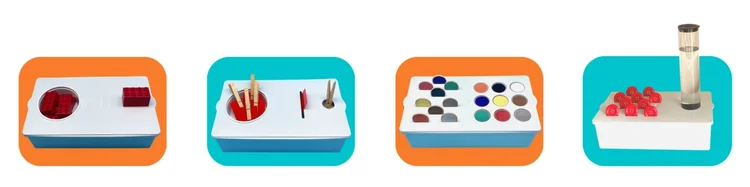
A few years back, Linda Larsen attended a TEACCH workshop where introducing change was the topic. She came away from this talk with the inspiration for a new ShoeboxTask® which we named, Variations. This task offers three different objects for the purpose of using them in three different ways. It is a reliable teaching model for demonstrating the flexible use of materials.

Top view of Task 37 – Variations  

ShoeboxTasks® are designed to mirror life’s experience and visa-versa. Using an idea, and applying it to a real-life scenario, (in this case, finding new ways of using any given material), opens the door to an expansive and creative relationship with the world.

Thank you, and as always, questions about any of this information can be directed to Ron at ron@shoeboxtasks.com.


Article of the Month

Click the title below to read our article of the month…


Customer Testimonials - we love to hear from you!

"ShoeboxTasks® are true to their mission in everything they do. Not only do they send out high quality learning materials to children on the spectrum, they provide an excellent work environment for adults on the spectrum."  

~ Hannah Pinkerton

Have you achieved success or overcome challenges with the help of ShoeboxTasks®? If so, we would love to hear from you!

Please share your discoveries and experiences with us at information@shoeboxtasks.com and we will send you any Task of your choice, for FREE! (Limited to the first 10 customer testimonials received).

Thank you so much, we look forward to hearing from you!


Educational activities designed for children with autism

There are 37 different ShoeboxTasks® - visit our website to find out more!

 SHOP NOW 
 
facebook youtube pinterest

ShoeboxTasks, 2004 Riverside Drive, Loft 2, Suite S, Asheville, NC 28804, United States

ShoeboxTasks

Unsubscribe